搜尋結果
共
168
筆符合商品
排序
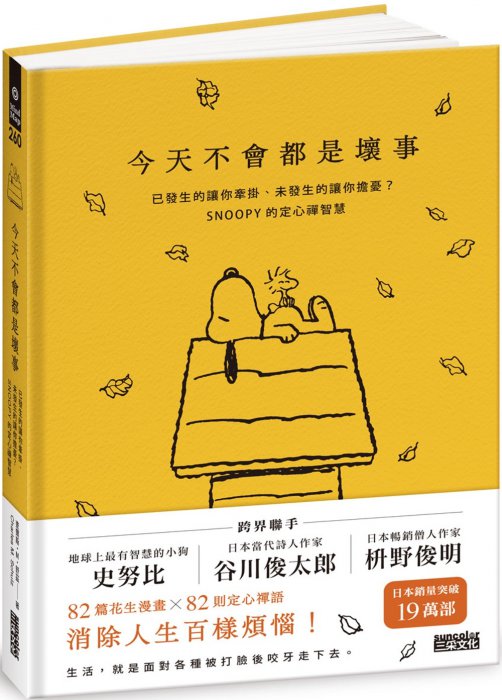
今天不會都是壞事:已發生的讓你牽掛、未發生的讓你擔憂?SNOOPY的定心禪智慧
史努比、谷川俊太郎、枡野俊明跨界聯手82篇花生漫畫 ╳ 82則定心禪語,消除人生百樣煩惱生活,就是面對各種打臉,咬牙走下去。沮喪、低潮、不安,讓史努比的禪智慧陪你定心。 【當你覺得好多雜事阻礙了夢想】史努比:「還有好多該去的地方,該做的事,該學習的事!」There are places to go, things to do, and lots still to learn!禪語:步步是道場【一堆事要做、卻件件都顧不好】莎莉說:「最好的生活方式,就是一天一天地過。」Best way is just to live one day at a time.禪語:喫茶喫飯【當你埋怨這世界不公平時】奈勒斯說:「雨會下在好人和壞人身上。」It rains on the just and the unjust.禪語:誰家無明月清風當史努比遇上禪學,用漫畫理解禪意,找到正向人生的療癒之書!
本書特色花生漫畫中英對照呈現花生漫畫全員演出,生活是由一個個當下所累積,眼前即是最好;學習活在今日,而不是寄望明天。史努比地球上最有智慧的小狗由史努比貫穿其中的《PEANUTS》漫畫,描述查理布朗等一群小學生的生活,連載50年,全世界超過170家媒體刊登,堪稱20世紀影響力最大的漫畫。作者查爾斯 ·M ·舒茲藉由四格漫畫傳達的名言、哲理,廣為讀者喜愛。媒體曾評價:「具有社會學、心理學和哲學價值。」谷川俊太郎日本當代詩人作家原味翻譯《PEANUTS》漫畫御用譯者,從同為哲学家、茶道美學專家的父親谷川徹三身上流露的禪心獲得感知,為長達50年的連載做最完美的詮釋。枡野俊明日本暢銷僧人作家全面監修曹洞宗德雄山建功寺住持,日本版《新聞周刊》選為「世界最尊敬的一百位日本人」之一,為本書的每字每語做最嚴謹的把關。
作者簡介
查爾斯 ·M ·舒茲 Charles M. Schulz1922年生於美國明尼蘇達州明尼亞波利斯。透過函授教育方式學習繪畫,矢志成為漫畫家。第二次世界大戰時從軍之後,24歲時以報紙連載作品的方式正式出道,從此開啟長達五十年的《PEANUTS》漫畫創作生涯。日版文字/谷川俊太郎1931年生於東京。詩人。21歲時出版《二十億光年的孤獨》。從1960年代後期開始翻譯《PEANUTS》漫畫,完成《完全版 花生漫畫全集》(河出書房新社出版)。日版監修/枡野俊明1953年生於神奈川縣。曹洞宗德雄山建功寺第十八世住持。多摩美術大學環境設計學科教授,也是庭園設計師。2006年,被《新聞週刊》日本版選為「深受世界尊敬的100位日本人」,有多本著作。
譯者簡介
楊明綺東吳大學日文系畢業,曾赴日本上智大學新聞學研究所進修。譯作有《六個說謊的大學生》、《蜜蜂與遠雷》、《漣漪的夜晚》、《咖哩時間》、《村上私藏---懷舊美好的古典樂唱片》、《超譯尼采》、《接受不完美的勇氣》等。
譯者
楊明綺
NT$
$425
|
85折

重振西藏文化的密續佛教
即使是在至暗時刻,灰燼中的火苗也得以重燃。撥爐有火,謹以此書的中譯出版,獻給先賢勇士。
對於西藏佛教歷史或教義感興趣的讀者來說,這是一部難得的讀本。
「這本書是藏學家羅納德.戴維森的代表作之一,反映的是歷史文獻學者視角下的西藏歷史與教法演變,特別是薩迦派道果系統教法的文獻成型過程。希望此中譯本的出版,對於臺灣佛學、藏學研究社群,能有所助益。」——梅靜軒〈導讀〉
西元950~1200年之間的西藏社會,是如何從武裝游擊兵的交鋒與體制崩潰的邊緣,轉化為由瑜伽士與學者所引導的佛教文化世界?
作者羅納德.戴維森(Ronald M. Davidson)認為這是由於一群活躍於此時期的僧侶、瑜伽士與貴族們合力激盪出的成果。西藏僧侶與瑜伽士翻譯了大量的印度佛教典籍。他們運用這些密續佛教的文獻與修持法為基礎,重塑西藏宗教、文化與政治體制。最終促成了西藏佛教的崛起,乃至取代印度,成為全亞洲的佛教文化中心。
作者生動地描繪了這些現身歷史舞台的人物,引領讀者觀看一群宗教菁英與權貴之士,如何打造出一個佛教文化世界,徹底地改變了西藏社會與文化的發展方向,鮮活地呈現了中世紀西藏發展的內在張力與轉型過程。
作者簡介
羅納德.戴維森(Ronald M. Davidson)美國加州大學柏克萊分校佛學研究博士,費爾菲爾德大學(Fairfield University)宗教學教授。他曾與藏人一同學習十多年,並與多位學者合作研究藏文典籍,以傳統方式學習儀軌與教義。著有《印度密教:密教運動社會史》(Indian Esoteric Buddhism: A Social History of the Tantric Movement)作者,並與史蒂文.古德曼(Steven D. Goodman)合編《西藏佛教:理性與啟示》(Tibetan Buddhism: Reason and Revelation)。
譯者簡介
黃書蓉:專任譯者陳桂芬:國立臺中科技大學兼任英文講師、法鼓文理學院佛教學系碩士班學生釋若理:香林精舍翻譯組組長 陳美靜:輔仁大學全人教育中心兼任講師、國立臺灣師範大學翻譯研究所碩士畢業洪琬雯:法鼓文理學院佛教學系博士班學生
潤飾者簡介
梅靜軒:法鼓文理學院佛教學系副教授
譯者
黃書蓉、陳桂芬、釋若理、陳美靜、洪琬雯;校潤:梅靜軒
NT$
$780
|
78折

純植甜點素學研究室
顛覆純素的刻板印象,讓人一吃就驚豔的好滋味!不使用雞蛋和奶油要如何打造美味甜點呢?公開東京素食甜點專賣店「Dragon Michiko」的獨門祕訣!#5大類甜點X 42種延伸口味#非素食者也會感到驚艷【本書七大重點】★ 無論純素者或非純素者都覺得美味可口!不使用雞蛋、奶油、牛奶或任何動物性及乳製品的甜點,一般人或許會感到卻步,然而本書不僅採用對身體負擔較小的原料製作,味道溫和,而且有著如同一般西點的質地和口感,讓人一吃就愛。★ 讓人想一做再做的簡單食譜本書盡可能省略繁瑣的步驟,模具方面也使用全家大小容易食用的尺寸,適合親子同樂,初學者亦能輕鬆上手。★ 以一年四季都能取得的食材為主為方便大家製作,本書盡量以一年四季都能輕鬆取得的食材,以及當下流行且深受大眾喜愛的食材為主,讓你三百六十五天都能做出想吃的甜點。★ 簡單易懂的「基本」每一章節都有「基本款」的食譜,以非常詳細的方式解說製作過程,在製作各章節甜點之前,務必把握好基本款。 ★ 原味款與變化款只要掌握了原味款,就可以任意做出自己喜歡的其他口味。若喜歡現成的變化款,也可以按照食譜輕鬆製作。★ 美味可口的祕訣大公開不使用雞蛋和奶油要如何打造美味甜點呢?本書將公開東京素食甜點專賣店「Dragon Michiko」的獨門祕訣,聊一聊隱藏在食譜裡的想法與用心良苦。★ 新鮮食材為美味加分採用新鮮食材讓甜點更美味,也是為了身體健康,本書列出使用食材,方便核對找尋。【5大類甜點】★ 蛋糕12款廣受歡迎的蛋糕,有各種不同口味,如:草莓、蘋果、香蕉、鳳梨、咖啡、抹茶等,除了基本磅蛋糕款式外,也有使用模型製作的咕咕霍夫蛋糕。★ 馬芬適合早餐或下午茶、零嘴享用,一邊品嘗不同口味帶來的驚喜滋味,一邊享受麵糊帶來的濃郁鬆軟感,用楓糖漿搭配甜菜根糖,帶出具廣度的甜味。★ 布丁使用玉米澱粉和寒天還原布丁Q彈口感,別以為少了雞蛋就少了滑順感,用米飴替代才是關鍵,最後加上焦糖醬,讓素食布丁變得獨一無二。★ 餅乾圓形薄餅乾、雪球餅乾以及像爆米花一樣不規則的滴落式燕麥餅乾,除了品嚐不同口味,也要品嘗不同口感,入口即化、酥脆爽口,盡情享受小零食的樂趣。★ 司康同時教你製作壓模司康和滴落式司康,每種食譜都適用這兩種形式,強調香氣與酥脆口感,或另外準備楓糖漿淋上,再搭配一壺茶。
作者簡介
山口道子曾任職於咖啡館,負責料理餐點和製作甜點的工作,自2010年起自學製作純素甜點。2013年起的3年間於一家純素甜點咖啡館擔任甜點師傅,並且晉升為店長。2018年1月獨立創業,開設一家專賣純素甜點和咖啡的小咖啡館「Dragon Michiko」。獨創的甜點既清爽又具滿足感,讓不少客人因驚艷而露出燦爛笑容。店裡時常洋溢著一股溫暖氣息,吸引不少忠實顧客再三造訪。
作者
譯者
龔亭芬
NT$
$306
|
85折

我很好,請再愛我一次
一枝塑膠牙刷的心聲,你願意傾聽嗎?英國CLPE國小教育文學中心推薦書你每天都有刷牙嗎?你的牙刷是塑膠做的嗎?如果是的話,你又丟棄了多少個「薩米」呢?薩米是蘇菲亞最喜歡的黃色牙刷。有一天,媽媽發現薩米的刷毛已經分岔,於是把他扔掉了,薩米開始一段驚心動魄的旅程。即使在汪洋中迷路,薩米仍然想回到小主人蘇菲亞的身邊,因為被使用、被愛是世界上最幸福的事。本書特色★ 你知道哪裡有最多的塑膠垃圾嗎?我們的海洋﹗平均每分鐘都有大約一卡車的塑膠垃圾落入海洋,海洋裡有大型的塑膠垃圾,也有細小到我們看不到的塑膠碎片,而這些塑膠都有可能被海洋生物吃掉。小讀者可以透過《我很好,請再愛我一次》看到塑膠製品離開小主人,意外落入海洋的過程,並且了解塑膠對海洋生態的影響。★ 尋找塑膠朋友再利用的價值,永遠選擇再愛他們一次。有些讀者認為實踐資源回收就好,但是,其實回收箱的物品只有一小部分能被回收再利用,而且這些塑膠只能被降級回收,做成品質差、功能少的產品。因此,相較於丟棄愛我們的塑膠朋友,我們可以選擇找到他們的其他價值,再次使用他們,再次擁有幸福。透過《我很好,請再愛我一次》一起思考你我身邊塑膠朋友的價值吧﹗
作者簡介
M. G. LeonardM. G. Leonard從2010年開始關注海洋汙染的問題,並且持續提倡環境保護的議題。2018年,M. G. Leonard加入Authors4Oceans,Authors4Oceans是由一群兒童作家鼓吹的運動,他們希望透過故事讓孩子了解大自然,並且培養他們對環境保育的熱情。M. G. Leonard加入Authors4Oceans後,創作出她的第一本塑膠繪本《我很好,請再愛我一次》。
作者
譯者
張之逸
NT$
$339
|
85折

(英文版)雜阿含經研究論文集 Research on the Saṃyukta-āgama
This is the fourth volume of proceedings of the Āgama seminars convened by the Āgama Research Group at the Dharma Drum Institute of Liberal Arts (formerly Dharma Drum Buddhist College). It comprises nineteen studies, contributed by eighteen different scholars, on various themes related to the Connected Collections of discourses (suttas, sūtras) — Saṃyutta-nikāya in Pali, Saṃyukta-āgama in Sanskrit — transmitted by different early Buddhist lineages of reciters, preserved in their Indic originals in Gandhari, Pali and Sanskrit as well as in Chinese and Tibetan translations. This research draws attention to fundamental methodological points posed by the study of these scriptural collections as windows into the formation of early Buddhist texts and the organisation of their transmission.
作者簡介
About the editor:Bhikkhunī DhammadinnāDharma Drum Institute of Liberal ArtsAbout the contributors:Oskar von HinüberAlbert-Ludwigs-Universität FreiburgBhikkhu AnālayoUniversität HamburgRupert GethinUniversity of BristolRichard SalomonUniversity of WashingtonMark AllonUniversity of SidneyJoseph MarinoUniversity of WashingtonJin-il Chung (鄭鎮一)Akademie der Wissenschaften zu GöttingenPeter Skilling (Bhadra Rujirathat)École française d’Extrême-OrientJens-Uwe HartmannLudwig-Maximilians-Universität MünchenYao Fumi (八尾 史)Waseda Institute for Advanced StudiesBhikkhunī DhammadinnāDharma Drum Institute of Liberal ArtsBhikkhu PāsādikaAcadémie bouddhique Linh-SonBhikṣu Huimin (釋惠敏)Dharma Drum Institute of Liberal ArtsTaipei National University of the ArtsKarashima Seishi (辛嶋 靜志)The International Research Institute for Advanced Buddhology at Soka UniversityMarcus BingenheimerTemple UniversityKen Su [Su Jinkun (蘇錦坤) ]Āgama Research GroupChoong Mun-keat (鍾秉潔) [Wei-keat (煒傑)]University of New EnglandStefania TravagninRijksuniversiteit Groningen
作者
NT$
$686
|
78折

The Infinite Mirror 寶鏡無境(英文版)
Here is the inimitable Master Sheng Yen at his best, illuminating the ancient texts of the Chinese Zen tradition to show how wonderfully practical they really are, even for us today. The texts, written by two of the founders of the Ts’ao-tung sect of Chan Buddhism, are poems entitled Inquiry into Matching Halves and Song of the Precious Mirror Samadhi. Both emphasize the Chan view that wisdom is not separate from vexation, and both speak of the levels of awareness through which one must pass on the way to realization. Both are also works of Buddhist philosophy that can serve as guides to spiritual practice for anyone.
作者
NT$
$646
|
85折

一顆橡實
因為一顆橡實,所以有了一棵樹、有了鳥巢……甚至,才有種子變成花朵。本書牽著讀者的手走過森林小徑,細看大自然中從一顆橡實起始的美妙連結。就從這一顆橡實開始,珍重地球上的每個生命。大自然中,生物之間緊密關聯,缺一不可。這本生態繪本像一首詩,利用一致的精巧句型和首尾頁挖洞設計,點出每頁看似靜謐而又生機蓬勃的生態變化。書中簡單的「因為……所以……」重複邏輯句型除了快速讓孩子了解生態系中不同物種間的關係,同時也引導孩子觀察圖像,看背景中有哪些生物,並猜猜下頁會出現什麼。藉此幫助孩子推敲出上下句間較為抽象的時間間隔和自然中的動態變化,理解食物鏈與動物行為等概念。書末附有生態介紹文章,帶孩子深入認識一座森林中的生物,並學習如何從日常生活中保護森林。
作者簡介
蘿拉.薛弗美國童書作家,已出版280餘本書籍,有18年的教學經驗。作品曾獲多項兒童文學獎項,例如夏洛特.佐羅托童書獎。她和先生泰德住在北喬治亞州的山區,喜歡在林間散步,留意周遭的所有事物──從小巧的橡實,到高大的橡樹。當蘿拉不在家中工作時,她會四處參訪學校,帶孩子們一起寫作。亞當.薛弗亞當和母親蘿拉一樣是童書作家,創作了數十本童書。這是他第一次和母親共同創作。亞當白天在市立政府機關工作,利用夜間寫作。他從小就喜歡爬樹,到現在還是一樣。
繪者簡介
弗蘭.布萊斯登-佳農居住在倫敦的插畫家與設計師。畢業於英國金斯頓大學。2011年,她獲選加入桑達克交流計畫,在圖畫書大師莫里斯.桑達克身邊學習一個月。她的作品曾獲英國水石書店兒童書獎提名,並入圍格林威大獎。
譯者簡介
凌拂目前專事寫作,著有《世人只有一隻眼》、《與荒野相遇》、《山.城草木疏》、《甲乙丙丁:十七個寬容等待的教學故事》、《帶不走的小蝸牛》等,曾獲聯合報文學獎、時報文學獎、開卷好書獎、洪建全兒童文學獎等獎項。為一自然崇拜者,曾索居深山,靜觀人世間的種種流變,一切有如細草微風;或消或長,唯有自然的嬗遞盡在無聲之中。其面對生命,有兩種滋養源源不斷,一是文字,一是自然。文字令其深入;自然令其出離。近年這兩種滋養逐漸匯聚,讓她在佛學裡安頓。
NT$
$255
|
85折

(英文版) 長阿含研究Dīrgha-āgama Studies
The present book collects research papers by Bhikkhu Anālayo containing translations of Dīrgha-āgama discourses and comparative studies of their Pāli parallels (as well as relevant Sanskrit fragments), together with three appendices. Several chapters and the appendices are devoted to examining aspects of the early Buddhist oral transmission. In addition, topics taken up in the course of this book are the analysis of views in the Brahmajāla, healing in early Buddhism, the Buddha's last meditation, his display of fire miracles, levitation, debating strategies, and the future Buddha Maitreya.
作者簡介
Bhikkhu Anālayowas born in Germany in 1962 and ordained in Sri Lanka in 1995. He completed a Ph.D. thesis at the University of Peradeniya (Sri Lanka) in 2000 and a habilitation thesis at the University of Marburg (Germany) in 2007. At present he is a professor at the University of Hamburg, Numata Center for Buddhist Studies (Germany).
作者
NT$
$546
|
78折

(英文版) 中阿含經研究論文集 Research on the Madhyama-āgama
This is the third volume of proceedings of the Āgama seminars convened by the Āgama Research Group at the Dharma Drum Institute of Liberal Arts (formerly Dharma Drum Buddhist College). It collects academic contributions on various aspects related to the Middle-length Collec¬tions of discourses (sūtras, suttas) transmitted by different early Buddhist lineages of reciters, preserved in their Indic originals in Gandhari, Pali and Sanskrit as well as in Chinese and Tibetan translations.
作者簡介
About the editor:Bhikkhunī DhammadinnāDharma Drum Institute of Liberal Arts
About the contributors:
Mark Allon & Blair SilverlockUniversity of Sydney
Bhikkhu AnālayoUniversity of Hamburg
Roderick S. BucknellUniversity of Queensland
Jin-il Chung(鄭鎮一)Göttingen Academy of Sciences
Takamichi Fukita(吹田隆道)Bukkyō University
Jen-jou Hung(洪振洲)Dharma Drum Institute of Liberal Arts
Seishi Karashima(辛嶋靜志)The International Research Institute forAdvanced Buddhology at Soka University
Michael RadichVictoria University of Wellington
Richard SalomonUniversity of Washington
Peter SkillingÉcole française d’Extrême-Orient
Ingo StrauchUniversity of Lausanne
作者
NT$
$351
|
78折

(英文版) 增壹阿含研究 Ekottarika-āgama Studies
The present book collects research papers by Bhikkhu Anālayo with translations of Ekottarika-āgama discourses and comparative studies of their Pāli parallels, together with three appendices on the terms Mahāyāna, Hīnayāna, and Theravāda. Several papers study aspects of the Ekottarika-āgama as a collection distinct from other Nikāya and Āgama collections. In addition, topics taken up in the course of this book are seclusion, the lion's roar, the wheel-turning king, Paccekabuddhas, and the four noble truths, as well as depictions of accomplished nuns and their significance.
作者簡介
Bhikkhu Anālayo was born in Germany in 1962 and ordained in Sri Lanka in 1995. He completed a Ph.D. thesis at the University of Peradeniya (Sri Lanka) in 2000 and a habilitation thesis at the University of Marburg (Germany) in 2007. At present he is a professor at the University of Hamburg, Numata Center for Buddhist Studies (Germany).
作者
NT$
$530
|
78折

Liberated in Stillness and Motion 動靜皆自在(英文版)
Live a life of ease and freedom, on the basis of peace and solidity, with the principle of being less agitated and affected.
Many masters in the history of Chinese Chan Buddhism emphasized practice as daily living. Whether monastic or lay, a follower uses the concepts and methods of Chan in daily life. By doing so, one experiences calmness and ease while being spontaneous and lively amidst mundane reality. Chan is not a religion, not a philosophy, and surely not mysterious or weird sorcery. It is the wisdom of living, the cultivation of body and mind, and a principle and guideline for spiritual development. It is also the best method for influencing and purifying the environment.--Master Sheng Yen
作者簡介
Master Sheng Yen (1930-2009)
Master Sheng Yen was born in 1930 and became a monk in 1943. He conducted a six-year solitary retreat, after which he went to Japan for further study and obtained a doctorate in Buddhist literature at Rissho University. In 1975, he began sharing the Dharma in the US, and in 1989, founded the Dharma Drum Mountain organization. In 2005, he established the Dharma Drum Lineage of Chan Buddhism, as an effort to reinvent Chinese Buddhism.
He authored more than 100 publications in Chinese, English, and Japanese, and received the Sun Yat-sen Art and Literary Award, the Sun Yat-sen Academic Award, and the Presidential Cultural Award, among other honorary awards.
He proposed the vision of "uplifting the character of humanity and building a pure land on earth," founded the Chung-Hwa Institute of Buddhist Studies, Dharma Drum Institute of Liberal Arts, and Dharma Drum Sangha University. Experienced in Chan using correct approaches, he guided practice in both the West and East. Popularizing the Dharma in modern language, the Master initiated movements including Protecting the Spiritual Environment, Four Kinds of Environmentalism, the Fivefold Spiritual Renaissance Campaign, and the Six Ethics of the Mind. He shared the Dharma globally with a broadminded perspective, winning him worldwide recognition.
作者
NT$
$281
|
78折

(英文版) 雜阿含研究 Saṃyukta-āgama Studies
The present book collects research papers by Bhikkhu Anālayo with translations of Saṃyukta-āgama discourses and comparative studies of their Pāli parallels, together with two appendices on the relationship between commentary and discourse as well as on the Udāna collection. Topics taken up in the course of the studies are the four noble truths as a diagnostic scheme, concern for the welfare of others, the transfer of merit, humour, Aṅgulimāla, teachings to laity, attitudes towards nuns, arahants and suicide, teaching and awakening, the gender-inclusiveness of the address 'monk', the acrobat simile, mindfulness of breathing, the Buddha's first discourse, self-cremation, and the Buddha's visit to his mother in the Heaven of the Thirty-three.
作者簡介
Bhikkhu Anālayowas born in Germany in 1962 and ordained in Sri Lanka in 1995. He completed a Ph.D. thesis at the University of Peradeniya (Sri Lanka) in 2000 and a habilitation thesis at the University of Marburg (Germany) in 2007. At present he is a professor at the University of Hamburg, Numata Center for Buddhist Studies (Germany), and a researcher at the Dharma Drum Institute of Liberal Arts (Taiwan).
作者
NT$
$484
|
78折

靜心冥想的練習:28天在家自修的正念課程(隨書附贈冥想導引MP3光碟)
呼吸本身就擁有無盡的能量。只要你會呼吸,你就可以靜心冥想!
美國知名靜心導師雪倫.薩爾茲堡將逾三十年的教學經驗,濃縮成28天的自修課程。每天20分鐘,連續4週,你就能體驗超越一切理解的平靜與快樂。
.《紐約時報》排行榜暢銷書,Amazon讀者評價4.5顆星.「正念減壓」創始人、《當下,繁花盛開》作者 喬‧卡巴金博士 熱情推薦.冥想導引MP3光碟:收錄了作者雪倫.薩爾茲堡親口錄製的冥想操導引練習,就像是雪倫老師為你開設專屬課程一樣。(中英文雙語錄製,合計共18首曲目,總長約129分鐘)
你常為明天憂慮,忘了接納當下嗎?你容易失眠、緊張、憂鬱、焦躁不安嗎?你想慈悲待人,卻總是以情緒失控收場嗎?你認為真正的快樂離你很遙遠嗎?
告別煩躁,體驗真正的快樂,就從每天練習靜心冥想開始!跟著MP3光碟中老師的引導同步實作,輕鬆易學、隨時靜心!
靜心冥想的好處在哪裡?
過去15年來,全球腦神經科學家一再證實,靜心冥想有助於:◎身體放鬆 ◎消除緊張壓力 ◎改善分心、強化專注力 ◎開發創意及學習能力◎降低血壓 ◎緩解慢性疼痛 ◎減緩腦部老化 ◎培養耐心與慈悲心
腦神經科學家和心理學家已經證實,大腦對於外在事件的經驗感受,可以透過特定訓練而不斷重組更新。靜心冥想就是這種「換腦袋」的方法之一。透過冥想,你有機會向內觀照自己的心,看見真實良善的自己;當心煩意亂時,你可以透過冥想,提醒自己處在正念之中,享受真正放鬆的愉悅;透過冥想,你的身體健康、情緒和行為,會有驚人的正向轉變,而後喜悅、幸福、快樂、正面能量便油然而生。
美國知名靜心導師雪倫.薩爾茲堡,從三十年來教授靜心冥想的經驗中去蕪存菁,以最簡單、人人都做得到的「呼吸」為基礎,為初學者規劃一個28天的正念課程。你可以搭配隨書附贈的MP3光碟,跟隨清楚的語音指引,按部就班完成:「呼吸靜心」、「行走靜心」、「情緒靜心」、「慈愛靜心」等等,簡單易學。
靜心冥想沒有任何條件限制,不受限於任何宗教信仰,人人都可以在生活中落實。只要持之以恆,你的人生可能就此改觀,變得更柔軟、更有創造性、更平靜、更清明和更平衡。你會在冥想的世界中,享受你從未體驗過的安心、真實、包容,以及無盡的愛。同時,你在練習冥想的過程中可能會發生的問題或疑惑,本書都有提供詳盡的解答。
為什麼這是實踐靜心冥想的最佳入門書?
本書共分為兩個部分,第一部分理論篇,先從科學研究的角度,提出靜心冥想的好處及種種科學根據;第二部分實踐篇,則有是為期28天的正念靜心課程,共有20個冥想操練習,每天只需花20分鐘跟著書中的步驟練習,就可以重拾身心平靜。像是:
◎第一週 全神貫注:練習專注呼吸和重頭開始的藝術〔冥想操1〕 核心靜心:呼吸 〔冥想操2〕 聆聽靜心〔冥想操3〕 放掉念頭的靜心 〔冥想操4〕 隨時可做的迷你靜心◎第二週 正念和身體:放掉包袱〔冥想操5〕 身體掃描靜心 〔冥想操6〕 行走靜心〔冥想操7〕 身體感覺靜心 〔冥想操8〕 日常活動靜心〔冥想操9〕 喝茶靜心◎第三週 正念和情緒:處理想法和感覺〔冥想操10〕 情緒靜心 〔冥想操11〕 召喚痛苦情緒的靜心〔冥想操12〕 正面情緒靜心 〔冥想操13〕 思考靜心◎第四週 慈愛:培養慈悲心和獲得真正的快樂〔冥想操14〕 核心靜心:慈愛 〔冥想操15〕 情緒或身體受傷時所做的慈愛靜心〔冥想操16〕 給看護者的慈愛靜心 〔冥想操17〕 看到優點的靜心〔冥想操18〕 安撫內在批評的靜心 〔冥想操19〕 行走時的慈愛靜心〔冥想操20〕 慈愛圈靜心
親自解答你練習時會遇到的常見問題
Q:當我開始靜心冥想時,對呼吸變得太過在意,我怎樣才可以正常地呼吸呢?Q:我在靜心時沒辦法阻斷雜念。靜心不是應該什麼都不想嗎?Q:為什麼當我拚命想要放空時,心裡卻不斷浮現某一個人的身影?Q:該如何避免在冥想時打瞌睡?Q:當我坐著感覺膝蓋僵硬,我該不該調整姿勢,或者是不管它,繼續關注呼吸?……
針對每一週的練習主題,作者也從自己逾三十年來的教學經驗中,歸納出學習者最常發問的「常見問題Q&A」,以便輔助在家自修的讀者們,更快速有效地掌握靜心冥想得正確要領。
靜心冥想練習MP3光碟內容說明
本書隨附的靜心冥想練習MP3光碟,收錄了作者雪倫.薩爾茲堡親口錄製的冥想操導引練習。在閱讀本書的說明文字後,你不妨閉起眼睛來聆聽MP3,跟著雪倫老師的聲音,實際來做冥想操。這就像是雪倫老師為你開設專屬的一對一課程一樣。(中文版MP3,特別邀請台灣「華人正念減壓中心」創辦人之一胡君梅老師為讀者配音。)
●作者簡介:
雪倫.薩爾茲堡(Sharon Salzberg)
美國知名的靜心導師,曾在印度、緬甸、尼泊爾、不丹、西藏等國家追隨佛教大師修習,並與西方最重要的禪修大師傑克‧康菲爾德和約瑟夫‧葛斯坦共同創立「內觀靜心協會」(Insight Meditation Society),著有《不要綁架自己》、《慈愛和信心》(Lovingkindness and Faith)等暢銷書。
教授靜心冥想課程逾三十年,學生來自世界各地,跨越不同的生活經驗、種族背景和宗教信仰,並經常為《歐普拉雜誌》(O, The Oprah Magazine)長期撰文,受訪文章散見《時代》雜誌、《簡簡單單》(Real Simple)、《好家政》(Good Housekeeping)、《自身》(Self)、《香巴拉大日》(Shambhala Sun)、《更多》(More)等等刊物。
●光碟中文版口述者簡介:
胡君梅
當代正念領域經典書《正念療癒力》、《自我療癒正念書》譯者,台灣「華人正念減壓中心」創辦人。台北教育大學心理與諮商研究所碩士,政治大學宗教研究所碩士,並完成美國麻州大學醫學院正念中心(CFM)認證師資的所有訓練課程,直接師事「正念減壓」創始人喬‧卡巴金博士。目前以專業、成長、涵容、愛的精神,全心推廣正念減壓課程。
●譯者簡介:
李芸玫
曾任職於報社、出版社、雜誌社,譯作及著作散見各出版社。深深相信除了哈利波特的魔法之外,這世界還存在著許多被忽略的魔法,譬如文字就是一種。
作者
譯者
李芸玫
NT$
$323
|
85折

(英文版) 長阿含經研究論文集 Research on the Dīrgha-āgama
This is the second volume of proceedings of the Āgama seminars convened by the Āgama Research Group at the Dharma Drum Institute of Liberal Arts (formerly Dharma Drum Buddhist College). On this occasion, the Āgama Research Group met to discuss the early collections of long discourses transmitted by the different Buddhist schools. Thanks to the discovery and ongoing publication of the incomplete Sanskrit Dīrgha-āgama manu¬script from Gilgit, three different versions of the Collec¬tion of Long Discourses are now avail¬able for comparative study: the Pali Dīgha-nikāya transmitted within the Theravāda tradition, the just-mentioned Dīrgha-āgama in Sanskrit, identified as Sar¬vās¬ti-vāda or Mūlasarvāstivāda, and the Chinese translation of an Indic Dīrgha-āgama (長阿含經), generally considered to be affiliated with the Dhar¬ma¬¬guptakas. The six papers collected here focus on research on these various incarnations of the collections of long discourses in comparative perspective.
作者簡介
About the editor:Sāmaṇerī DhammadinnāDharma Drum Institute of Liberal Arts
About the contributors:Bhikkhu AnālayoNumata Center for Buddhist Studies, University of Hamburg &Dharma Drum Institute of Liberal Arts
Roderick S. BucknellUniversity of Queensland
Toshiichi Endo (遠藤敏一)Centre of Buddhist Studies,The University of Hong KongJens-Uwe HartmannLudwig-Maximilians-Universität of Munich
Jen-jou Hung (洪振洲)Dharma Drum Institute of Liberal Arts
Seishi Karashima (辛嶋靜志)The International Research Institute for Advanced Buddhologyat Soka University
作者
NT$
$250
|
78折

《禪修FOLLOW ME》8冊特惠組合
掌握深層自信,享受每一天的快樂與平衡觀照自己、觀照世界,讓工作成為你的幸福存摺「我每天都會告訴自己:『今天是一個好日子,雖然可能會遇到一些麻煩,但這對我而言是正面的機會,我要感謝它給我歷練的機會。』」——聖嚴法師如果問:「誰給你最大的工作壓力?」答案應該就是自己。工作有壓力是正常的,但是心可以不被順境、逆境所左右。放下執著,就能釋放工作潛力。「放下」,並非「放棄」,而是放下心中的執著和成見,放下自己的主觀看法和喜好。我們與其說是放不下工作而煩惱,實則往往是放不下自己。聖嚴法師的四它心法:面對它、接受它、處理它、放下它,已經成為眾多人達成最佳工作狀態的心靈法則。套書精選聖嚴法師深具啟發的開示,專為解決上班族常見的煩惱,提供多種有效的放鬆禪法與紓壓心法,透過工作禪的訓練,讓工作變得輕鬆愉快,並以智慧應對種種困境。透過觀照自我和世界,掌握深層自信。工作與其聽天由命,不如隨順因緣、掌握因緣、創造因緣,開創自己的道路。透過工作,讓家人、同事、社會都因我們的努力而得到幸福。如果說工作是一份儲蓄、是一本存摺,我們所存入的絕不只是薪水,還有成長的智慧、奉獻的心力、廣結的人緣……,掌握每次藉事練心的培福機會,讓工作成為我們的幸福存摺! 組合內含:《放鬆禪:上班族40則放鬆指引》放鬆,是精進而從容自在。隨時隨地把波動的心安定下來,與壓力和平共處,享受慢活的創意與專注的高效率。《當下禪:上班族40則活在當下指引》當下,是最好的時段,這是時間管理的創新詮釋。鍛鍊自己一心無二用,時時刻刻全力以赴,步步都是進步的立足點。《幸福禪:上班族40則幸福指引》幸福,是自我肯定的微笑曲線。永遠保持平常心,融入未知的全球化世界,樂在學習,與創造力經濟接軌。《安身禪:上班族40則安身立命指引》安身,是動靜平衡的管理哲學。在瞬息萬變中,鍛鍊觀照自己、觀照世界的簡約法則,每個當下都是創新的原點。《安心禪:上班族40則安心指引》安心,是心平氣和的淡定智慧。在煩惱中練習正念與轉念,以境遇為師,啟發自我修復、自我導航的正向潛能。《放下禪:上班族40則放下指引》放下,是隨時得、隨時捨的歡喜心。思惟彈性來自因緣觀,以及分析力、組織力、同理心的高度協作,面對重重關卡,自然能舉重若輕。《快樂禪:上班族40則快樂指引》快樂,是與人為善的溝通藝術。語言不一定能達成共識,自我肯定的自知之明,自他平等的尊重、理解、如實接納,即是多元化與深刻國際化的素養。《紓壓禪:上班族40則紓壓指引》紓壓,是正念隨喜的深層自信。善觀因緣及因果,淡化煩惱與得失,不論處於職場的天堂或地獄,與自己同在,日日是好日。
NT$
$888
|
74折

An Early Chinese Commentary on the Ekottarika-āgama
This study reassesses an old problem in the history of Chinese Buddhism, the origins and nature of the Zengyi ahan jing 增一阿含經 (Taishō 125). It does so by a close investigation of the Chinese translation of the Ekottarika-āgama at the end of the fourth century and of its most important witness, the Fenbie gongde lun 分別功德論 (Taishō 1507). It is argued that the latter document, whose original title was Zengyi ahan jing shu 增一阿含經疏, should be seen as an unfinished commentary to the newly translated collection, produced within the original translation team (including Dao’an 道安, Zhu Fonian 竺佛念 and the Indo-Bactrian master Dharmananda) during the tumultuous end of the Qin秦 empire of Fu Jian苻堅in A.D. 385. This reconstruction yields further insights into the cultural origins of the Chinese Ekottarika-āgama, and its broader significance for the history of Buddhism.
作者簡介
Antonello Palumbo is Lecturer in Chinese Religions at the School of Oriental and African Studies, University of London
NT$
$359
|
78折

Things Pertaining to Bodhi: The Thirty-Seven Aids to Enlightenment 三十七道品:菩提之路
The Thirty-seven Aids to Enlightenment are a set of fundamental teachings of Buddhism in the form of a list. The list’s seeming simplicity belies the fact that it is in fact a kind of road map to enlightenment for anyone who follows it with diligence and sincerity. The Thirty-seven Aids comprise seven practices conducive to awakening. Each of the seven practices is itself a set of elements, which add up to the total of thirty-seven: (1) The Four Foundations of Mindfulness, (2) The Four Proper Exertions, (3) The Four Steps to Magical Powers, (4) The Five Roots, (5) The Five Powers, (6) The Seven Factors of Enlightenment, and (7) The Noble Eightfold Path. Master Sheng Yen’s down-to-earth teachings take the reader on a progression through each of the practices—many of which are familiar to all major schools of Buddhism—illustrating how they relate to the reader’s own practice on the path toward enlightenment.
作者
NT$
$791
|
85折

Madhyama-āgama Studies
The present book collects various research papers by Bhikkhu Anālayo with translations of Madhyama-āgama discourses and a comparative study of their Pāli parallels, together with a brief discussion, found in the appendix, of the school affiliation of the Madhyama-āgama and its relation to the Majjhima-nikāya. The main emphasis in these studies is on detecting possible transmission errors in the Pāli versions through the help of the parallel Madhyama-āgama discourse. Topics taken up in the course of the different studies are the Buddha’s decision to teach, the role of investigation in early Buddhism, the notion of a recluse, the relationship between tranquillity and insight, the lateness of the dictum that a woman cannot be a Buddha, the beginnings of the Abhidharma, meditation on emptiness in early Buddhism, the development of the arahant ideal, the canonical account of the founding of the order of nuns, and the relationship between karma and liberation.
作者簡介
Bhikkhu Anālayo was born in Germany in 1962 and ordained in Sri Lanka in 1995. He completed a Ph.D. thesis at the University of Peradeniya (Sri Lanka) in 2000 and a habilitation thesis at the University of Marburg (Germany) in 2007. At present, he teaches at the Center for Buddhist Studies, University of Hamburg, and researches at Dharma Drum Buddhist College (Taiwan).
作者
NT$
$507
|
78折

Research on the Ekottarika-āgama (Taishō 125)
This volume contains the proceedings of a workshop on the Chinese translation of the Ekottarika-āgama, the Zengyi ahan jing (增壹阿含經), Taishō no. 125, held at Dharma Drum Buddhist College in April 2012. The papers included focus on different aspects of the translation of this early Buddhist canonical collection: its school affiliation; the relationship of its textual materials to Indian Mahāsāṃghika and Mahāyāna milieux; the incorporation of late elements in the course of revisions or additions effected in China; collaborative quantitative text analysis and authorship attribution applied to verify the philological hypothesis of later additions to the collection; structural aspects that can be reconstructed on the basis of its summary stanzas and of scriptural quotations in other works.
作者簡介
Bhikkhu AnālayoUniversity of Hamburg, GermanyDharma Drum Buddhist College (法鼓佛教學院), Taiwan
Satoshi Hiraoka (平岡 聡)Kyōto Bunkyō University (京都文教大学), Japan
Jenjou Hung (洪振洲)Dharma Drum Buddhist College (法鼓佛教學院), Taiwan
Tsefu Kuan (關則富)Yuan Ze University (元智大學), Taiwan
Ken Su(蘇錦坤)Hsinchu City (新竹市), Taiwan
NT$
$273
|
78折

大師密碼M-S 第三輯組合(七冊合購 7書+7CD)
全彩精裝繪本、中英雙語系列書--《大師密碼》,附CD,專為國小中高年級、國中青少年量身訂做,故事精彩、插畫美不勝收、印刷精美,連大人也愛不釋手。 書中收錄五個精彩的大師故事,萃取大師的人格密碼,直接學習大師的 成功特質,適合忙碌的現代人,又絕對不失原味,是目前市面上最具創意,製作最精美的的佛教青少年繪本,培養優秀人格,同時學習英語,是學佛的父母最好的選擇,學佛的青少年們,也一定要看!
貼心設計‧專業編審
本書集合了當代優秀的文學作家、插畫名家、專業童書翻譯、中美英文審稿、佛學學者,全新創作出最適合青少年朋友閱讀的佛教勵志文學讀本。不但附送英文CD方便學習,並有「大師小檔案」、「佛學名詞解釋」、「英文單字表」,增強閱讀知識。所以閱讀本書,除可以學習大師們的經典智慧密碼,還可以提昇中文、英文的語言能力。 精美插畫‧美的饗宴
全套26集將由劉建志、果祥、林威敏、蘇力卡、劉小琦、沙奇...等多名專業繪者展現出大師密碼最耐人尋味的畫面,充分展現出大師世界的大格局,絕對是讓人值得好好珍藏的經典作品。
作者
NT$
$1,330
|
5折
正在載入更多商品......